At a Glance: Char Dham Helicopter Weight Limits & Surcharges (2027 Guide)
Embarking on the sacred Char Dham Yatra by Helicopter from Dehradun is India's most prestigious and spiritually uplifting luxury pilgrimage. However, high-altitude helicopter aviation is governed strictly by the unforgiving laws of atmospheric physics and DGCA safety regulations rather than commercial tour capacities. Understanding the exact 75kg–80kg passenger threshold, transparent per-kilogram excess weight surcharges, the strict 5kg soft-duffle luggage rule, and why hard suitcases are completely banned prevents humiliating deboardings and unexpected cash fines at Sahastradhara Helipad.
Guide Navigation & Key Modules
Module 1: The Physics of High-Altitude Helicopter Aviation: Why Weight Limits Are Matter of Life and Death
Operating helicopters across the high-altitude Himalayan shrines of Uttarakhand is fundamentally different from sea-level aviation. Weight limits are not an arbitrary airline baggage policy — they are calculated aerodynamic boundaries that determine whether an aircraft can safely take off from high mountain ridges.
1. The Density-Altitude Reality at 10,000+ Feet
- Rarefied Alpine Atmosphere: Helipads like Kharsali (Yamunotri — 8,400 ft) and Kedarnath Top (11,100 ft) operate in thin mountain air where atmospheric pressure and air density drop by 30% to 35% compared to sea level.
- Payload Performance Drop: A luxury high-performance turbine helicopter like the Airbus H125 (AS350 B3e) or Bell 407 that can easily carry 6 adult passengers and full fuel at Dehradun (2,100 ft) suffers a severe 35% to 40% loss in lifting payload capacity when landing and hovering out of ground effect (HOGE) in the rarefied atmosphere of Kedarnath.
- Afternoon Thermal Updrafts: As the midday sun warms the Himalayan valley walls, air density thins even further, forcing flight captains to reduce takeoff weights or split passenger groups.
2. The Strict DGCA Safety Mandate
Under Directorate General of Civil Aviation (DGCA) Civil Aviation Requirements (CAR), pilots must calculate the Maximum Takeoff Weight (MTOW) and center-of-gravity (CG) load sheet prior to every single takeoff. Overloaded helicopters face catastrophic vortex ring state (VRS) hazards, inability to maintain hover, and loss of tail-rotor authority during mountain gusts.
Module 2: The 75kg – 80kg Threshold & The Exact Excess Weight Surcharge Matrix (2027)
In our flagship luxury package (starting at ₹2,15,000 per person) and across standard DGCA-certified charter operators, base fares are calculated assuming an average passenger body weight baseline:
| Passenger Weight Category | Threshold Range | Excess Weight Surcharge | Operational Seating Action |
|---|---|---|---|
| Standard Baseline Weight | Up to 75 kg / 80 kg | ₹0 (Included in Base Fare) | Normal seat allocation as per load sheet |
| Moderate Excess Weight | 81 kg to 88 kg | ₹1,500 – ₹2,000 per extra kg | Counterbalanced by seating lighter passenger opposite |
| Heavy Excess Weight | 89 kg to 98 kg | ₹2,000 – ₹2,500 per extra kg | Fuel load trimmed; passenger assigned center seat for balance |
| Very Heavy (>98 kg) / Combined Couple >160 kg | >98 kg Individual / >160 kg Couple | Calculated per kg surcharge | Splitting Rule: Split across separate Kedarnath shuttle sorties |
Senior Aviation Operations Head Sachin Chauhan Explains: "The total combined passenger weight for a 6-passenger charter is strictly capped between 430 kg and 450 kg. If two traveling companions — such as a husband and wife — have a combined weight exceeding 150 to 160 kg, the pilot will seat them on separate shuttle sorties on the high-altitude Sersi/Guptkashi-to-Kedarnath leg. This is not discrimination; it is the aerodynamic law of weight-and-balance. Unethical brokers hide this during booking, leaving families feeling blindsided. At The North India Planner, we log exact weights upfront and guarantee complete transparency."
Module 3: Strict Baggage Limit: The 5kg Soft Duffle Bag Rule & Hard Suitcase Ban
Baggage limitations on helicopters are even more rigid than commercial airlines due to physical cabin dimensions:
Permitted: 1 Soft Duffle Bag (Max 5 kg)
Each passenger is allowed strictly ONE soft-sided duffle bag weighing a maximum of 5 kg. Flexible nylon or canvas duffle bags compress easily inside the narrow, curved rear baggage compartment of the Airbus H125 helicopter.
Strictly Banned: Hard Suitcases & Strolleys
Hard-shell polycarbonate suitcases, wheeled strolley bags, and oversized rigid backpacks are 100% PROHIBITED. Ground staff will refuse to load hard suitcases onto helicopters.
The North India Planner Seamless Baggage Solution
- Complimentary Aviation Duffle Bags: Upon arrival at your 5-star partner hotel in Dehradun (Hyatt Regency or Fairfield by Marriott), our flight operations team presents every guest with a complimentary, standard-sized aviation-grade soft duffle bag.
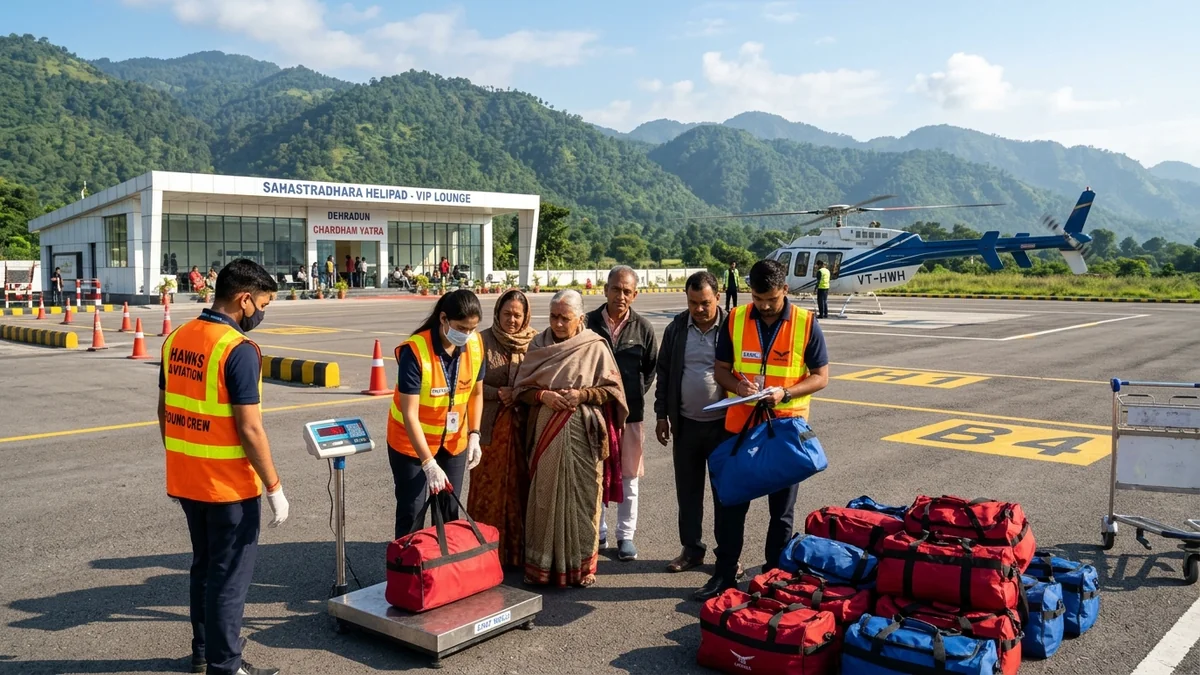
- 24/7 Sahastradhara Secure Locker Storage: Guests transfer 4 to 5 days of essential warm thermal wear and puja clothing into their soft duffles. All primary hard-shell suitcases, heavy trolley bags, and non-essential belongings are securely tagged and stored free of charge in our private, 24/7 CCTV-monitored locker facility at our Sahastradhara Helipad base.
Module 4: Day-by-Day Weight Weigh-In Protocols & Sahastradhara Departure Mechanics
Precision logging occurs every single morning to ensure absolute compliance with DGCA flight clearance:
- Day 1 Pre-Flight Weigh-In: During the 04:00 PM safety briefing on Day 1 in Dehradun, every passenger steps onto calibrated digital aviation scales holding their packed 5kg duffle bag.
- Load-and-Trim Sheet Compilation: The exact weights of all 6 passengers and fuel calculations are fed into the flight dispatcher's load-and-trim sheet to determine optimal center-of-gravity seating allocations.
- Morning Temperature Adjustments: If morning ambient temperatures at Kharsali or Kedarnath rise faster than forecasted, pilots have the statutory right to delay takeoff slightly or rearrange seat distributions to ensure a 100% safe climb gradient.
Module 5: The 4 Notorious Helicopter Weight & Booking Scams Exposed
Unscrupulous aviation aggregators exploit travelers' lack of technical knowledge. Beware of these 4 predatory practices:
Scam 1: The "Low Ball Package with Hidden Weight Surcharge" Trap
The Trap: Fly-by-night brokers quote an artificially low package rate (e.g., ₹1,75,000) to win bookings. They conceal the fact that their baseline weight is capped at an unrealistic 70 kg.
The Damage: On Day 1 at Sahastradhara, a family of four weighing 82–85 kg each is slapped with a surprise cash demand of ₹45,000 to ₹60,000 in "excess weight fines" before being permitted to board.
Scam 2: The Overloaded 6th Passenger Mountain Abandonment
The Trap: Aggregators sell all 6 seats to heavy passengers (>88 kg each). The helicopter reaches Kedarnath in cool morning air, but when afternoon temperatures rise, the pilot refuses to take off with all 6 passengers due to MTOW violations.
The Nightmare: The 6th passenger is left stranded on the mountain at Kedarnath with no hotel room or warm clothes while the helicopter flies away.
Scam 3: The Fake Emergency "Medical Weight Seat" Extortion
The Trap: Unregistered operators demanding ₹20,000 extra cash at Guptkashi claiming they must reserve an "emergency medical seat buffer" for senior citizens. No such official fee exists under DGCA regulations.
Scam 4: The 50% Weather Cancellation Forfeiture Trap
The Trap: When DGCA grounds all flights due to dense mountain fog or torrential monsoon rain, rogue agencies pocket 50% of the passenger's fare citing "administrative holding charges."
The North India Planner Rule: We operate strictly under standard aviation transparent refund formulas: unutilized flight sectors are refunded promptly minus only statutory DGCA landing and heli-handling fees.
VIP Char Dham Yatra by Helicopter 2027 (5D/4N Dehradun to Dehradun)
Experience uncompromising luxury and safety. Includes private helicopter flights, 5-star hotel in Dehradun, luxury mountain resort stays, VIP Temple Darshans, complimentary aviation duffle bags, secure luggage lockers, and 24/7 expert flight operations managed by veteran manager Sachin Chauhan.
Module 6: Frequently Asked Questions (FAQ)
1. What is the passenger weight limit for Char Dham Yatra by helicopter?
Standard helicopter packages calculate base pricing assuming an average passenger body weight of 75 kg to 80 kg. For a standard 6-passenger charter, the total combined passenger weight is strictly capped between 430 kg and 450 kg due to high-altitude density altitude regulations.
2. How much is the excess weight charge per kg for Char Dham helicopters?
Passengers whose body weight exceeds the 80 kg threshold are charged an excess weight fee ranging from ₹1,500 to ₹2,500 per extra kilogram across the complete 4-Dham circuit to balance fuel trimming and load distribution.
3. Can we carry hard-shell trolley bags on Char Dham helicopters?
No. Hard-shell suitcases and wheeled strolley bags are strictly prohibited because they cannot fit inside the narrow, curved baggage compartments of Airbus H125 helicopters. Each passenger is allowed only ONE soft duffle bag weighing a maximum of 5 kg.
4. What happens if a passenger weighs more than 80 kg?
Passengers weighing over 80 kg pay a transparent per-kg surcharge. If the total combined weight of all passengers exceeds the helicopter's certified MTOW limit, passengers are redistributed across alternate sorties or lighter passengers are counterbalanced opposite them.
5. Why are couples sometimes separated on Kedarnath helicopter flights?
To comply with strict high-altitude weight-and-balance trim requirements on shuttle legs into Kedarnath (elevation 11,100 ft), pilots must ensure symmetrical lateral center of gravity. If two passengers have a combined weight exceeding 150–160 kg, they are seated on separate shuttle sorties departing just minutes apart.